
Different from a workshop
There are no assignments, no group exercises and no homework. Nobody has to come up with something or perform in front of colleagues.
So no reason to put off signing up.
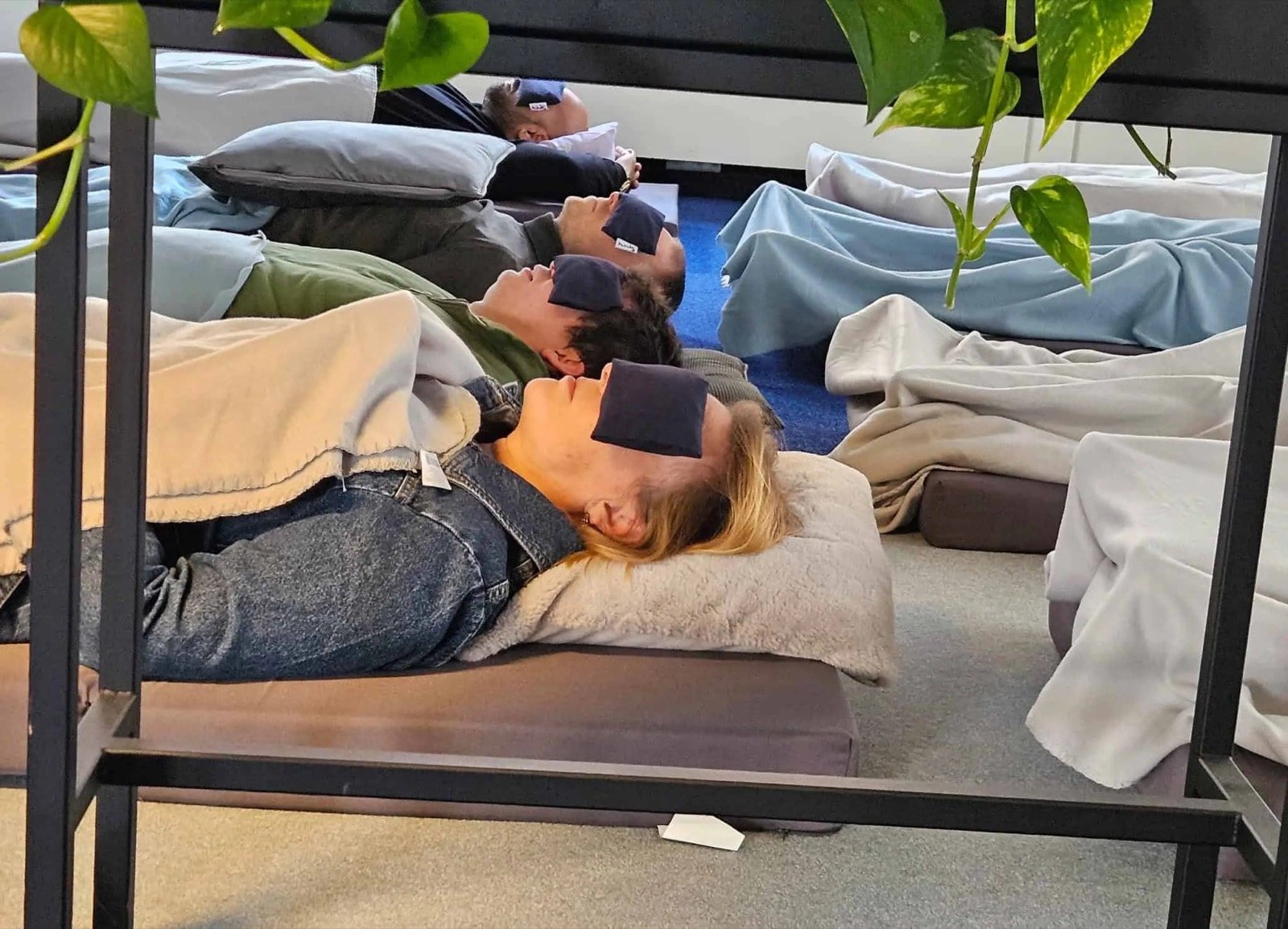
For 45 to 60 minutes, your colleagues lie under a blanket while gongs and singing bowls do the work. No exercises, no circle and no group sharing. I bring everything.
Previously delivered for teams at Secrid, ANWB, Frisse Blikken, ABN AMRO and Nationale-Nederlanden.
From € 22.50 per colleague. One round € 650 excl. VAT, theme week day with three rounds € 1,350. A proposal with a fixed price within one working day.
Why HR chooses this
In a lot of theme weeks it’s mostly the usual group that shows up. The rest drop out at the announcement, because they think they’ll need to be good at something, that it will get vague, or that they’ll have to share something about themselves. A sound bath removes those barriers before anyone signs up.
Up to twenty colleagues per round. Three rounds in one day: sixty.
There are no assignments, no group exercises and no homework. Nobody has to come up with something or perform in front of colleagues.
So no reason to put off signing up.
A good speaker gives people information about stress. That doesn’t make the tension itself any less.
Here we don’t talk about calm, here the body gets a chance to actually feel it.
No fitness or flexibility needed, and no visible difference in ability between colleagues. You lie down or stay seated, and let it happen.
So the keen runner and the colleague who rarely joins in can lie side by side.
Prices
Each round has room for up to twenty people. If you want a whole department to be able to join, choose the theme week day: three rounds spread across the morning, lunch and afternoon. Setting up and travel happen only once, so each extra round costs relatively little.
Single
€ 32.50per colleague
€ 650 excl. VAT per round. For one team or an away day.
Recommended for a theme week
€ 22.50per colleague
€ 1,350 excl. VAT per day: three rounds, up to 60 colleagues.
For a smaller group
€ 42.50per participant
€ 850 excl. VAT per group: 1.5 to 2 hours, up to 20 participants.
For comparison. A half-day stress workshop in the Netherlands costs 75 to 200 euro per participant, a fifteen-minute chair massage 15 to 28. Here everyone lies down for an hour, with instruments, mats, blankets and eye masks included.
An example day. Set-up from 09:15, morning round at 10:00, lunch round at 12:15 and afternoon round at 15:30. A second day in the same week, at another office for example, is better value. Outside The Hague travel is € 0.25 per kilometre.
How it works
Fill in the week, the number of colleagues and the location. It takes two minutes.
With a fixed price you can put forward internally straight away. Once agreed, you get the text for the announcement.
I set up, play the rounds and pack everything up again. All you sort out is a quiet room.
You don’t have to believe in anything. You just have to lie down.
In the room
Nothing is asked of anyone. That’s not reassurance beforehand, it’s literally how the session is built.
The first few minutes
People come in and pick a spot on a mat or a chair. There’s a blanket and, for those who like it, an eye mask. I briefly explain what’s going to happen. There isn’t much more preparation than that.
The bulk of it
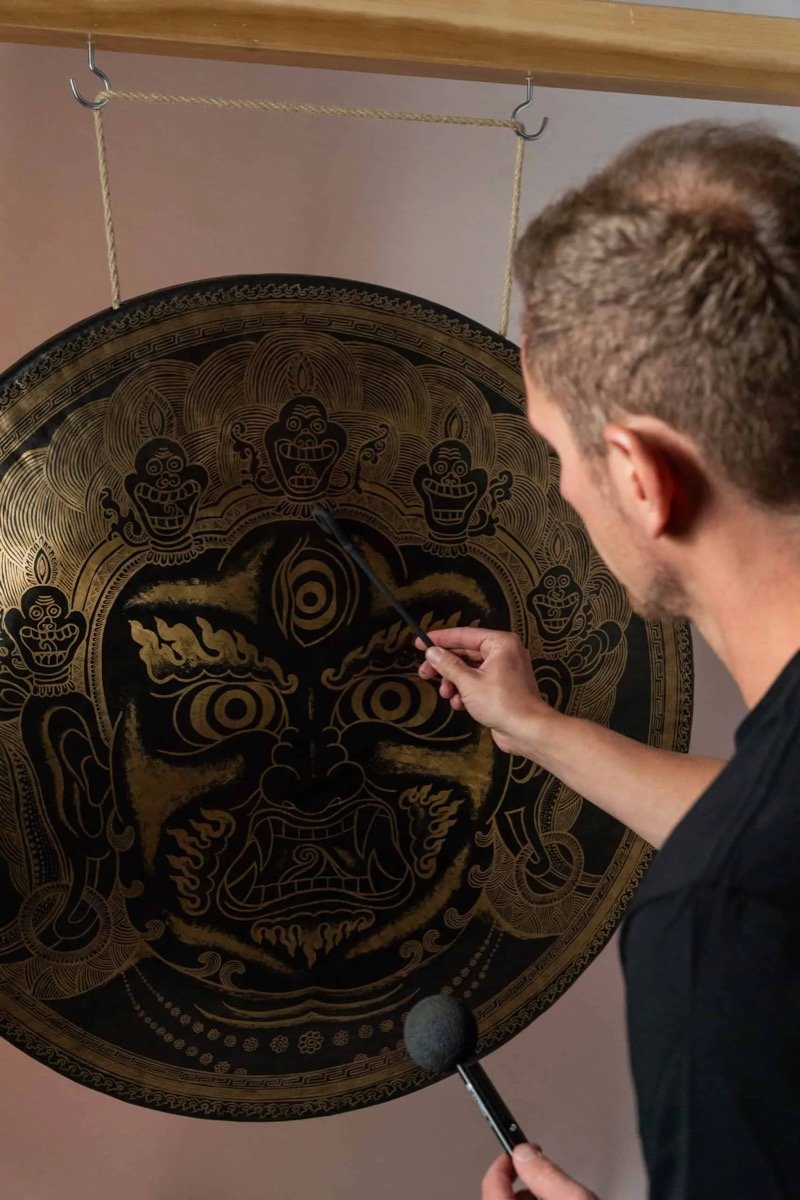
Everyone lies there relaxed. I play a gong, singing bowls and a number of smaller instruments. The sound comes from different directions, gets louder and softer again, and you don’t have to do anything with it. Some people fall asleep. That’s completely fine.
The last ten minutes
The sound slowly gets quieter until there’s nothing left. What remains is a silence that feels different from the one half an hour earlier. Then everyone comes back in their own time. There’s no group sharing at the end.
The lowest tones are usually something you feel before you hear them.
Why sound
Meditation is on almost every wellbeing programme, and it’s also exactly where most people drop out. Sitting still and holding your attention feels more like a task than a rest for a lot of colleagues.
In a sound bath, the sound holds the attention. Many participants notice their breathing settle, their shoulders drop and their thoughts slow down, without having to focus on an exercise. Colleagues who were least into it beforehand are often the most surprised afterwards.
And because you’re lying next to colleagues you usually only see in meetings, people often leave the room not just calmer, but a little more connected to each other too.
From earlier teams and theme weeks
Previously ran sessions for
We thoroughly enjoyed the sound bath evening. A special and beautiful experience.
Practical
All the instruments, plus a mat, a blanket and an eye mask for each participant, up to twenty per round. You don’t have to buy or hire anything. No experience needed, no sportswear, and everyone can join in, lying down or sitting.
A quiet room where the group can lie on the floor, plus around 5 m² for the instruments. A door that closes, phones off and no coming and going during the session. Setting up takes 45 minutes beforehand, packing up 30 minutes after. Loading and parking close to the entrance please, because the gong is heavy.
Who stands in front of the group
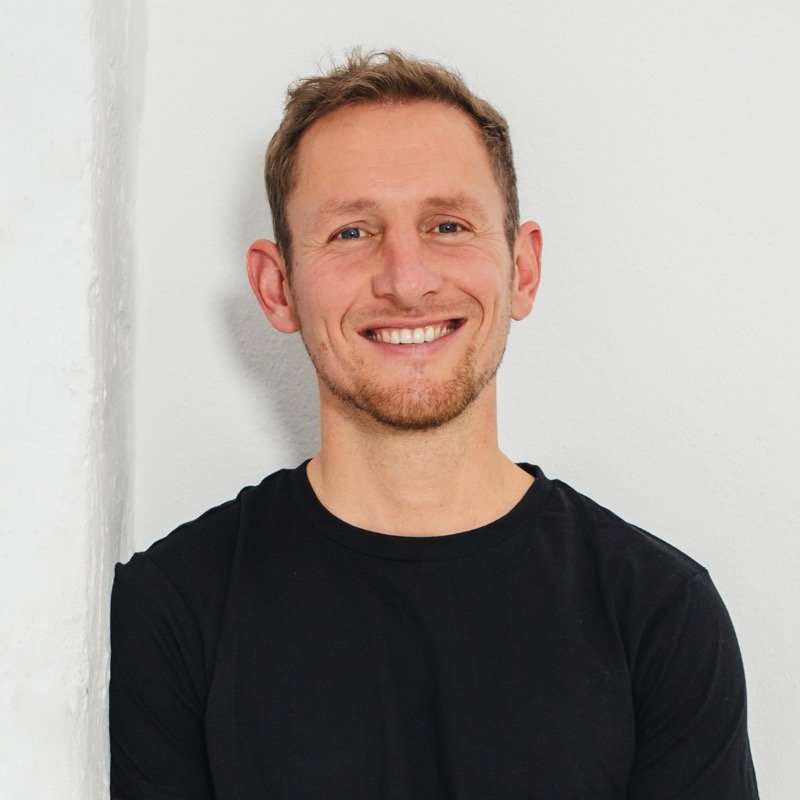
I spent twelve years in consulting, in serious gaming and learning design. I know the inside of an organisation, the diaries that fill up and the kind of day where you only notice in the car home how tense you actually were.
After that I specialised in what happens in a body under that pressure. I trained as a breathwork facilitator and learned to work with sound in Rishikesh, India. I’ve run sessions for teams at Secrid, ANWB, Frisse Blikken, ABN AMRO and Nationale-Nederlanden, among others.
You can’t explain calm. You can only feel it.
To be clear: I don’t turn up in a suit.
Questions that always come up
A single round costs € 650 and a theme week day with three rounds € 1,350, both excluding VAT. Breathwork and sound bath together, 1.5 to 2 hours, costs € 850. Outside The Hague I charge € 0.25 per kilometre for travel. You get a proposal with a fixed price within one working day, so you can put it forward internally without guesswork.
Up to twenty per round, because that is the number of mats I bring and the group size where the sound works best. If you want to reach more colleagues, I play several rounds in one day: a theme week day reaches sixty, and eighty with a fourth round. I can also help with sign-ups per round. If you want the whole group at once, that works when the venue provides mats, cushions and eye pillows; we agree that together.
A round takes 45 to 60 minutes. Breathwork and sound bath together takes 1.5 to 2 hours, depending on your wishes. On top of that I need 45 minutes to set up and 30 minutes to pack up.
Three things help most. Rounds at different times, so every schedule has a slot. An announcement that says you don’t need to be good at anything and don’t need to share anything; I supply that text. And a fixed slot in the diary, so it doesn’t get squeezed out between two meetings. Anyone who couldn’t make it gets the ten-minute recording.
Those are often the ones it works best for. Nothing is asked of you and you don’t have to believe in anything. The biggest sceptic in the room is regularly the one who is most surprised afterwards at how far they went under.
A reasonably quiet room where twenty people can lie down. A cleared meeting room, a canteen outside lunch hours or a gym all work. I think along with you beforehand about the layout and the acoustics.
No. You just have to lie down, or stay seated if lying down doesn’t work. No experience is needed and you don’t have to be flexible. I do ask everyone to take their shoes off, it relaxes better and it keeps the mats clean.
That’s completely fine. It happens more often than you’d think.
If you’re pregnant or have epilepsy, a pacemaker, heart or vascular problems or high blood pressure, just let me know beforehand. Then we’ll sort out where you’re most comfortable and I’ll adjust the session.
I can usually fit something in two to three weeks ahead. Around the national wellbeing week in September and the work stress week in November the requests pile up, so ideally book two months ahead.
Yes, I work throughout the Netherlands. Outside The Hague I charge € 0.25 per kilometre for travel, and that’s simply in the proposal.
Of course. Teams also book a sound bath to close an away day or quarterly meeting, or as a team evening. A single round usually fits those best.
That’s the nicest route. The theme week lets people feel once what sound does to them, and the weekly programme keeps that going in small steps afterwards. That way more of the week stays with people than one nice day.
Request a proposal
Let me know which week it is, roughly how many colleagues want to join and where. Within one working day you’ll have a proposal with a fixed price that you can put forward internally straight away.
Rather talk it through first? Book a short twenty-minute call, or email me your question.