Weekly relaxation programme for employees Seven minutes where nobody wants anything from you.
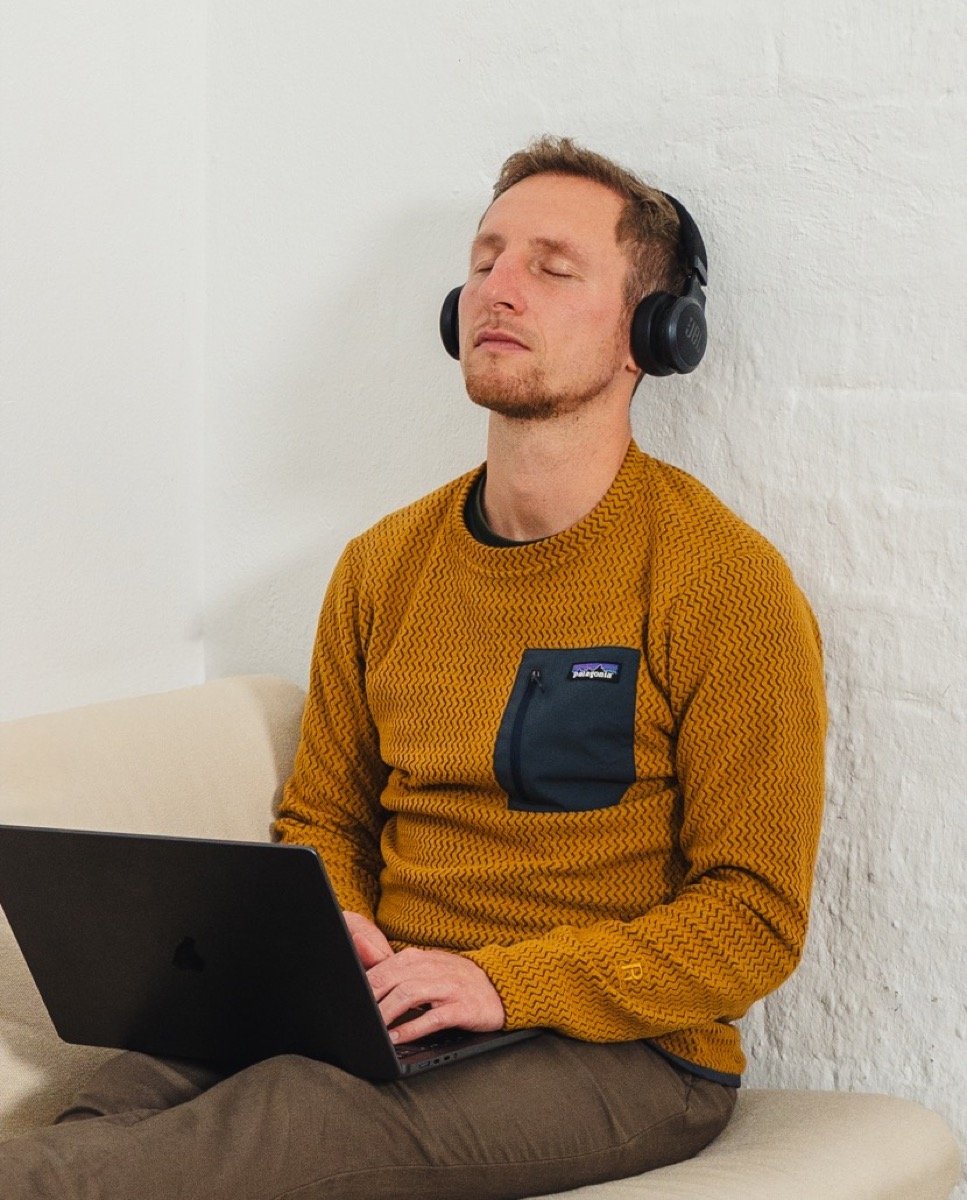
Every week there's a short breathing exercise and sound session of seven minutes, ready for your people to do in a break. In a proper mute-break, on the headphones they already have on. No app, no login, no group sharing. Just a moment to let your head go quiet.
For contact centres, customer service, and any team that's switched on all day.
7 minper session
Microbreak that fits the schedule
From € 250per department per month
Easyno extra systems or logins
What happens
Seven minutes out of a working day. This is what happens.
The tension from one call is usually still in the body when the next one comes in. That stacks up over a shift, and over a week. A short interruption brings the pile down before it gets too high.
09:41
It piles up
14 still in the queueAHT is in the redthat caller was shoutingticket 4471 openbreak in 40 min
Five things at once, and never a moment when it goes quiet.
09:42
Seven minutes
Short breathing exerciseMini sound sessionAHT is in the redthat caller was shouting
Headphones on, eyes closed. The work drops away and something calmer takes its place.
09:48
Back, with a clearer head
14 still in the queue
The queue is still there. The difference is what the next caller runs into.
You don't go to the gym once a year and expect it to stick. Lowering stress works the same way: it only does something if you keep at it.
For HR and operations
Absence rarely comes from one hard day.
It comes from tension that never fully drops. At a desk you still walk to the printer now and then. In customer contact there's no moment that happens by itself. That's exactly the gap this fits into.
Tension that stays put
Every call asks for attention and the right tone all over again. Without a moment of recovery, the next conversation starts with the tension of the last one still in the body.
MuteMinute helps you build a structural recovery moment into the day.
Low enough to actually use
Programmes that ask for time, sign-ups or an app get skipped first by the people under the most pressure. Exactly the group you wanted to reach.
Seven minutes, no sign-up, no separate login.
Something that gets used
A fruit basket and an annual workshop look good in the wellbeing plan, but change little about an eight-hour shift behind a screen or a phone.
Daily repetition instead of a one-off.
What it costs your schedule. Seven minutes per employee, from once a week to once a day. That's up to you. For a team lead who says they can't spare anyone, that's the whole conversation. We deliver the material, you decide when people are scheduled.
The maths
What it costs, and what it returns.
Take a team of thirty. An investment in wellbeing and lower stress of seven minutes per person, every working day, comes to about 96 working days a year. It's a real number, and it looks like a lot.
Look at the absence figures and you see where the return sits. Only eight percent of sick leave reports last longer than six weeks, and that small group causes three quarters of all sick days. When someone drops out through stress or burnout, it lasts eight to ten months on average. A single case costs a team more than a full year of mute breaks for thirty people.
Break time · the whole team of 30 · one year
96 working days
One employee on long-term absence
180 to 215 working days
What you keep in the year you prevent one case
83 to 118 working days
Prevent one such case and a full year of mute breaks for thirty people has paid for itself. With more than eighty working days to spare.
Figures on absence duration and distribution: ArboNed and HumanCapitalCare, 2024. The average absence of eight to ten months is converted into working days, so both bars use the same unit. The lighter ends show the top of the range. Nobody can guarantee this prevents that particular case, absence always has more than one cause. And what this sum doesn't count: everyone who doesn't tip over, but does get through the day calmer.
What your team gets
Two things every week, to take the edge off.
A breathing exercise
A guided breathing exercise of five to seven minutes that you do sitting down, at your own desk or somewhere else. You don't have to be able to do anything and you don't have to perform. Most people notice their shoulders drop within a couple of minutes.
A sound session
A recording with sounds that slow brainwaves down and help the body settle, made to listen to on headphones. All you do is listen. It gives the effect of a deep meditation, without anyone having to meditate.
Listen for one minute
A fragment from a sound session. Put on headphones: the sound is made for two ears and doesn’t work through a speaker.
Why a sound session calms you down so quickly
In this short video Jens explains how sound affects your brain, and what that actually does for you. Complex material, explained clearly in under four minutes.
How it reaches them
We match that to whatever already works for you. By email, a message on WhatsApp or Teams, or a tile on the intranet. There's nothing to install and nobody has to create an account.
From yes to running
Live in three steps, no IT project.
Step 01
Intro call
Twenty minutes. We look at what rhythm suits you, from once a week to daily, and which channel we use.
Step 02
Pilot with one team
We start small, so you see what it does before you roll it out wider. You don't have to build or connect anything.
Step 03
Running weekly
Every week the new sessions are ready on the agreed channel. You plan the moment, we deliver the content.
No accounts, so no personal data. Employees don't have to register anywhere, so there's no record of who listens and who doesn't. That saves a GDPR conversation, and it takes away the pressure that puts people off in the first place.
Who makes this
I'm Jens.
I'm a breathwork facilitator and sound healer in The Hague. Before this I spent twelve years as a consultant at various corporates, so I know the world your people work in. Full diaries, high expectations, and few moments to properly step out of it.
I've run sessions for teams at Secrid, ANWB, Frisse Blikken, ABN AMRO and Nationale-Nederlanden, among others. MuteMinute is what I saw working there, turned into something that comes back every week instead of once a year.
You can't explain calm. You can only feel it.
Questions that always come up
Any questions?
How much time does it actually cost us?
That's up to you. It can be anything from one seven-minute session a week to two a day. I'd recommend one session per full eight-hour working day. That's enough to notice the effect and small enough to schedule.
Do employees have to install anything?
No. They get a link, press play and put their headphones on. There's no app, no account and no password.
What if someone isn't into this?
Then they don't join in, and that's fine. There's no attendance list, no circle and no evaluation form. Precisely because nothing is required, fewer people drop out than with a compulsory workshop.
How do we know it's being used?
Because there are no accounts, we don't track who listens. What we can do is a short anonymous survey in the team after a pilot, so you can judge from the reactions whether it lands.
Can we try it first?
Yes. I'd rather start with a pilot in one team than a signature for the whole organisation. Then you see for yourself what it does before you roll it out wider.
Which languages are the sessions in?
English and Dutch. Mixed and international teams can all take part, nobody has to switch.
Is this woo-woo?
No. You don't have to believe in anything, nobody asks how you feel and there's no candle involved. You breathe differently for a few minutes, or you listen to sound. Sceptics are welcome, the physiology works either way.
What it costs
A fixed price per employee, with volume tiers.
You pay per employee per month, and that figure drops as the team gets bigger. Every department pays a minimum of € 250 a month. You start with a three-month trial, so you can see whether it suits your team first.
What it comes to for you depends on the team size. In a twenty-minute intro call I'll just work it out with you.
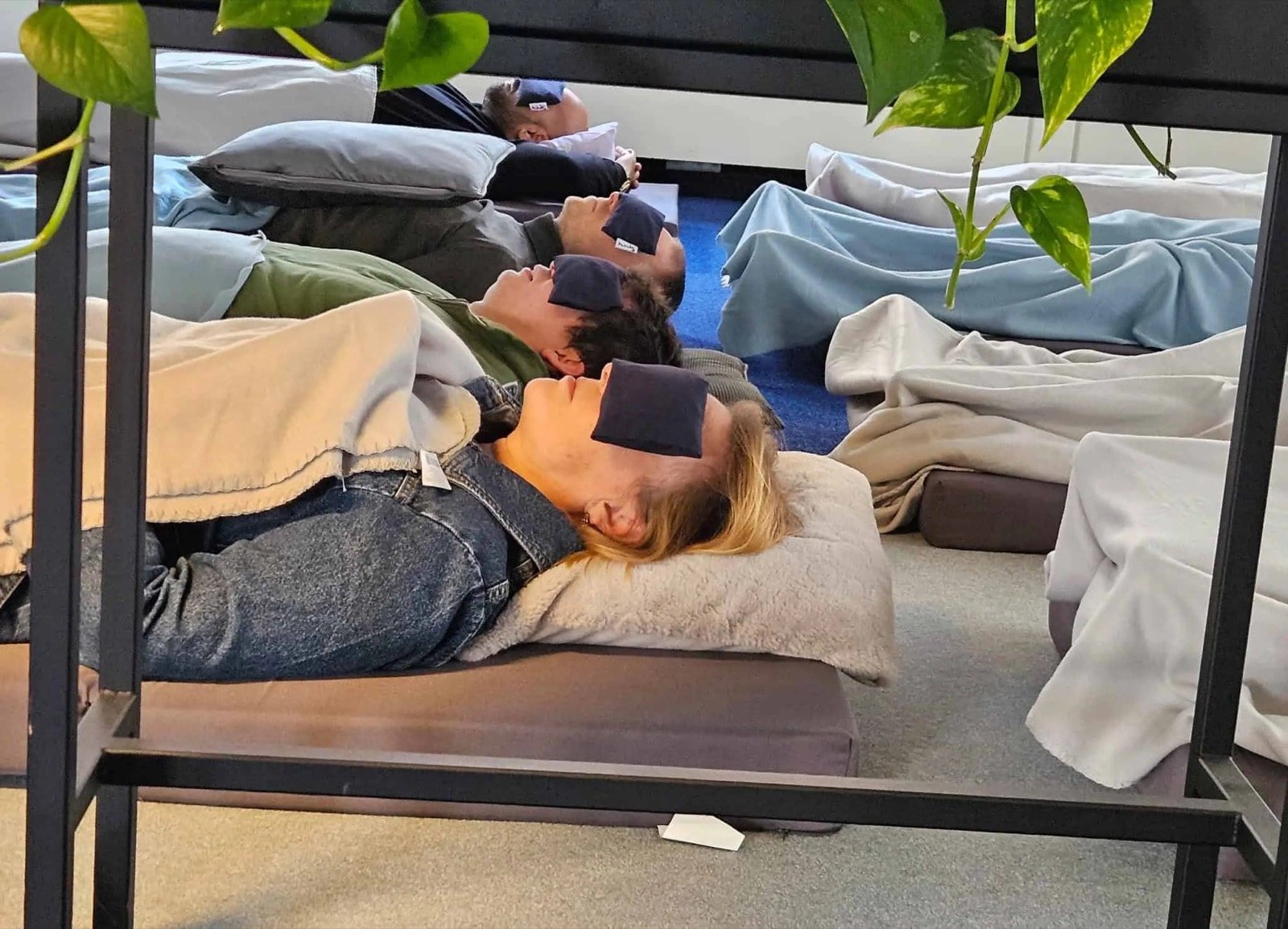
Organising a wellbeing week or another theme week? Then I come over with gongs and singing bowls for a sound bath, in three rounds in one day so everyone can join. The colleagues who skip yoga or a workshop do turn up for this. A theme week day starts at € 1,350.
A lot of teams start this way, and keep it going afterwards with the weekly programme.
In a twenty-minute intro call we look at whether this fits, how it reaches your people and what a pilot would cost. No presentation, just a conversation.